

Espresso Machines - Which One is Right For Your Home?
The top espresso machines are easy to use, simple to clean and can produce rich and balanced shots. What are the steps to choose the best espresso machine for your home?
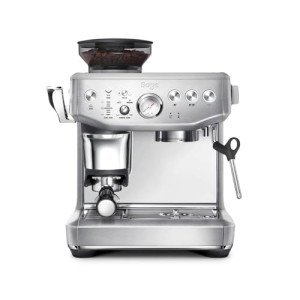
This Breville model is ideal for those who don't wish to learn barista techniques, but still want to enjoy great coffee at home.
Pump-driven
Pump-driven machines make use of an electric pump to deliver the force required to make espresso. These machines typically either accept water from a mains supply, which is common in commercial installations or a reservoir which has to be filled manually (common with household and smaller commercial espresso machines). The pumps used are typically solenoid-piston models that can produce high pressure. Certain espresso machines with pumps have a fixed flow regulation and others allow you to adjust the pre-infusion and/or brewing pressure.
The most well-known type of machine, they are a great option for those who want to make quality coffee quickly and consistently. They are also simpler to clean and maintain than other types of machines however, they require some electricity and a location near an outlet.
They come in two basic varieties: semi-automatic and super-automatic. Semi-automatics allow you to control how long the shot is pulled by using an electronic switch or a programmed function. You can also control the grind setting, and tamp down the coffee. Certain semi-automatics feature rotary motors, while others vibrate. Rotary pumps are quieter and more consistent but require a continuous flow of pressurized water.
A vibrating pump, on the other hand, is able to start with a quiet start. However, it could make a loud noise once water is added to the machine. Both have pros and cons, and you should pick the one that fits your lifestyle best.
Pump-driven machines also come in a range of sizes and price. The most expensive machines are usually super-automatic and come with multiple boilers that separate the water used for brewing and steaming. These models come with heat exchangers that can be set at different temperatures to allow for an array of flavors. This feature is ideal for the busy barista at home, but it will increase their price. Semi-automatics are a good middle place. They can be reasonably priced however they don't have the same level of consistency and versatility of other options.
Steam-driven
A steam-driven machine employs an easy mechanism to make an espresso that is strong. In an airtight container, hot water is steamed to create pressure, which is transferred to the coffee grounds to make espresso. This is similar to what happens inside the stovetop moka pot, and these machines are popular today due to their low cost and small size. These models aren't capable of achieving the 9 bars of pressure required for a truly espresso. These models are ideal for those just starting out making espresso at home or those who don't worry about making the perfect espresso.
The 1878 compensation siphon balancer designed by German engineer H. Eicke is a very early steam-driven machine. The steam produced by this device is pushed through a filter of ground beans, which are then depressurized with the help of heat from an open flame spirit burner. This process produces a very powerful shot, however it isn't up to the standards of consistency that many coffee lovers would prefer.
Luigi Bezzera patented improvements in 1901 which led to the next breakthrough. The design of his invention allowed him to reduce the temperature in the boiler. This enables more consistent temperature and pressure control. Bezzera added the piston device to make the machine semi-automatic. The only issue was that the barista had to grind and measure beans manually.
espresso makers www.coffeee.uk led to the creation of a pump-driven espresso machine. In contrast to the steam-driven machines of the past that were heated with an open flame, this new type of machine is equipped with an electric pump that is capable of generating the high levels of pressure required for the brewing of espresso. These machines can either accept water directly from the cold water line common in commercial installations or they can utilize a separate tank filled with water manually.
The machines also come with two temperature settings that are controlled by one button. One of these buttons is activates the brew thermostat while the other switches on the steam thermostat. This type of machine is more accurate than older steam-driven machines and can provide consistent shots at a fraction of the cost of more expensive models.
Semi-automatic
Semi-automatic machines are a great option for those who want to brew their espresso quickly and efficiently. It eliminates barista training by automating the process of grinding, tamping, and extraction to produce consistently good results. It does not do all the work for you. You still have grind the beans, tamp them down in the portafilter and then push the water through.
Many amateur and professional coffee-lovers prefer to use semi-automatic machines for this reason, as they enjoy being more involved in the process of making coffee. They also come with an affordable price compared to their fully-automated counterparts, and they are also known to be more reliable, too.
These espresso machines are typically found in coffee shops that are not specialty and in homes of casual coffee lovers who are willing to pay more for convenience. Dual boilers permit the steam and brewing to remain separate. One is used for heating, while the other is used to prepare your preferred beverage. Some models come with a built in grinder which can save the user much time.
However the built-in grinder typically has a limited selection of settings, which can be frustrating for those interested in tinkering with the process of brewing espresso to make their own personal favorite. It is best to use a semi-automatic espresso machine with an external grind to ensure full control over the size of the grind.
If you're interested in a semiautomatic espresso machine, look for one with a low-noise, high-quality electric pump and a temperature controller that permits precise temperature control. The PID is typically found in top-quality toasters and immersion circulators. It helps stabilize the brewing process by analyzing the temperature fluctuations throughout the heating cycle.
In addition, a good semi-automatic machine must have a sufficient steam wand to produce microfoam, and also be able to switch between brewing and steaming modes with ease (if it doesn't include dual boilers). A semi-automatic model with all of these features could be an excellent choice for those who don't wish to learn how to make cafe-quality drinks however, they nonetheless want to play.
Manual
Manual espresso machines are operated by levers that push coffee grounds pressurized through the bed. This results in high-quality shots. They are typically less expensive than semi-automatic or fully automated counterparts, making them popular for those who appreciate a fine cup of coffee.
Manual espresso machines require greater attention and experience from the operator in order to maximize their potential. Selecting the right grinder, making sure that the brew ratio is in order and knowing how to dose and tamp your grounds are just some of the things you'll need be aware of before using a manual espresso machine.
While some people may find the learning curve involved in operating a manual machine frustrating, for those who have the right abilities, it is well worth the effort. The expert barista at CHOICE, Adrian Lini, says that if you've got the right tools and the ability to learn the basics, a manual espresso maker can provide the ultimate espresso experience.
In recent years, the hand-operated coffee machine has evolved in both its form and function. It now comes with more advanced features, including digital pressure gauges, which allow users to monitor the pressure during extraction. Charles who works for Flair Espresso, says that the machines can be paired with Bluetooth devices to digitally draw graphs of flow rate. This aids users in understanding how the changing variables during extraction can impact the final result.
There are two types of manual espresso machines: direct and spring-piston. Direct levers are equipped with a spring in their group heads to boost pressure during the brewing process. They're more expensive than spring-assisted units, but can still be easier to use.
Springs piston machines are limited to the steam valve within their group head. They are more user-friendly but do not offer the same degree of control over the making process. Choosing the right type of machine is dependent on your personal preferences and budget. Whatever you choose, a manually operated espresso machine will require a few essentials that include an able filter as well as a coffee mill and a kettle.